4D or not 4D
A WebXR tesseract you can hold in your hands.
Try it yourself at 4d.3dwww.com — you'll need a WebXR-capable headset, like a Quest 3.
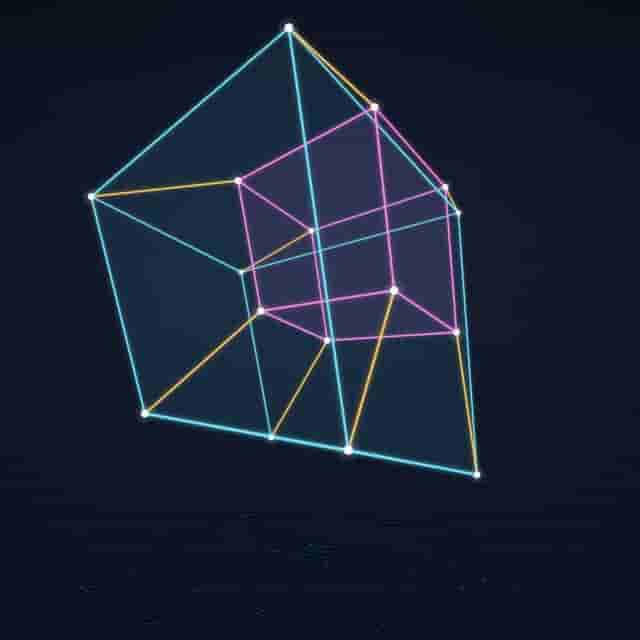
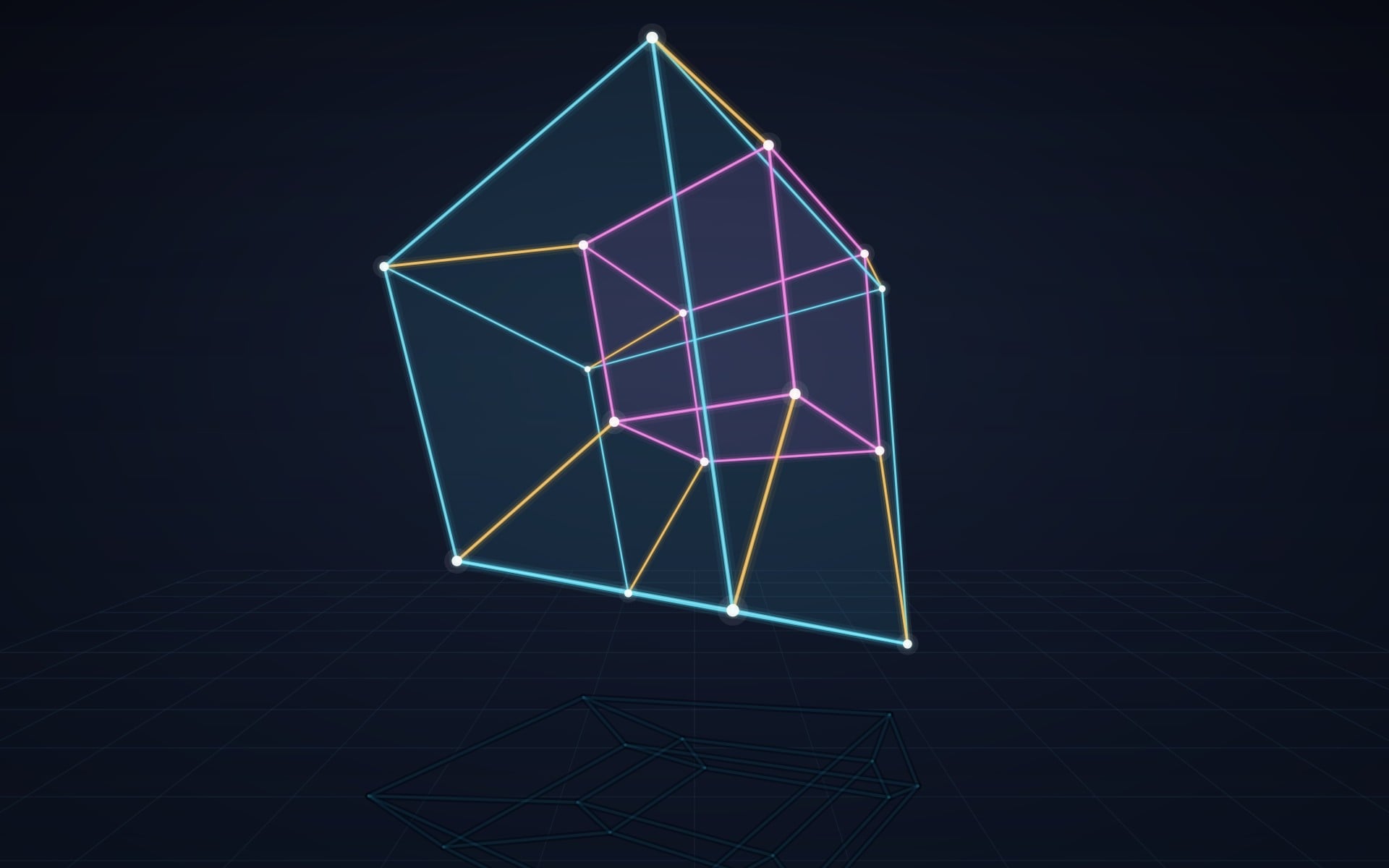
Everyone has seen a tesseract. It's that "cube inside a cube" wireframe that shows up in every article about the fourth dimension, usually next to a paragraph assuring you that mathematicians totally understand this stuff, and you shouldn't worry about it.
I've always found that deeply unsatisfying. Not because the picture is wrong — it's a perfectly correct projection of a real, mathematically exact four-dimensional object. It's unsatisfying because a picture of a tesseract is a 2D image of a 3D shadow of a 4D shape. Two steps removed from the thing itself. It's like trying to understand a sculpture from the shadow it casts on the pavement, in a photo, printed in a newspaper.
You can't see four spatial dimensions. Nobody can; our eyes and brains are built for three. But here's the thing I kept coming back to:
You don't need to see 4D to understand it. You just need the right kind of shadow — and the right place to stand.
Hold a cube up to a light and it casts a flat shadow. The shadow is distorted, angles look wrong, but rotate the cube and your brain effortlessly reads the 3D shape from the way the shadow morphs. That skill is ancient, automatic, and completely wasted on flat screens.
So I built the same trick, one dimension up. The tesseract in this app is a genuine 3D shadow of a genuine 4D object — sixteen four-dimensional vertices, honest 4×4 rotation matrices, real perspective division along the W-axis. Nothing is faked or hand-waved. And instead of flattening that shadow onto a screen, VR lets you stand inside it. You walk around it, lean into it, hold it in your hand and turn it — and your depth perception, that magnificent piece of evolved hardware, gets aimed at something it has never encountered before.
This is, I think, the only medium where this works. A 3D print of a tesseract is frozen at one orientation, and the whole point is what happens as it rotates through the fourth dimension. A screen animation strips away your stereopsis and gives you a projection of a projection. VR is the only format in which the deformation is actually legible.
And what a deformation it is. In 4D you don't rotate around an axis — you rotate around an entire plane. Grab a face and twist your wrist, and cells appear to swell, shrink, and pass through each other. None of that is really happening — in 4D every cell remains a perfect cube, every angle exactly 90° — the shadow just can't preserve it, the same way a cube's flat shadow can't keep its angles square. My favourite party trick is the double rotation: in 4D, two rotations can be completely independent of each other, spinning the object in two unrelated ways at once, with no net axis at all. It's impossible in 3D, it's hypnotic to watch, and I've yet to find a way to describe it in words that doesn't sound like I'm making it up. That's rather the point of the app.
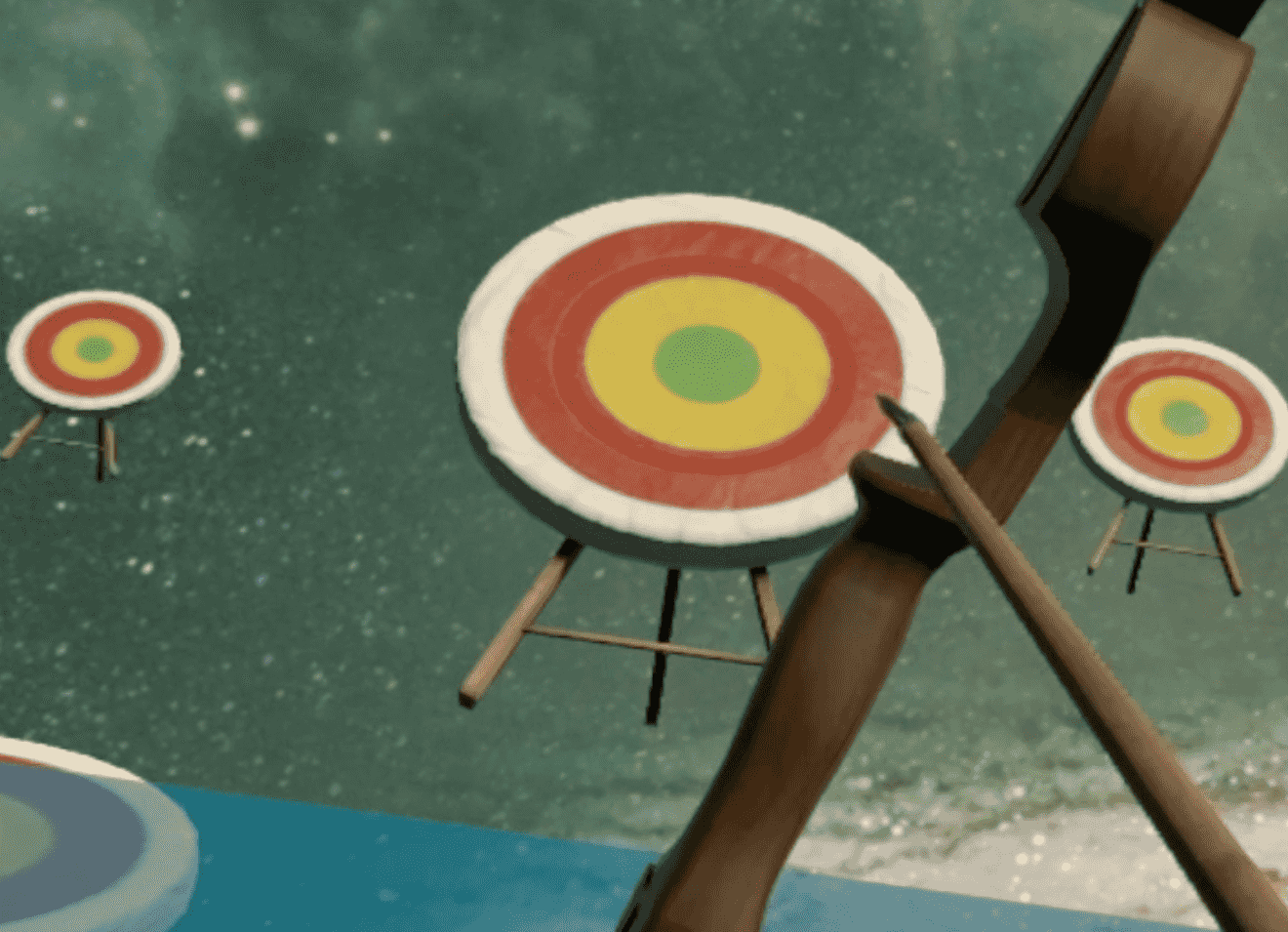
The nerdy bits: it's built with React Three Fiber, @react-three/xr and Three.js, running straight in the headset's browser — no app store, no install, just a URL. The 4D maths is a small pure library (projection, rotation planes, slicing), and the cells are drawn with a custom shader that uses multiply blending — a stained-glass effect I ended up with after discovering that ordinary transparency turns eight overlapping cubes into unreadable mush. There's an in-world tablet you can grab and resize, with settings, a guided tour of 4D concepts, and a little game where you race to overlap two highlighted vertices by rotating in 4D. Every rendering decision serves comprehension rather than photorealism; it's a maths lesson dressed up as a lava lamp.
My favourite feature, though, is the chirality demo. In 2D, no rotation can turn the letter p into q — you have to lift it off the page, through the third dimension. In 3D, the same is true of your left and right hands; no rotation can swap them. But passed through a 4D rotation, a left glove comes back as a right glove. The app lets you watch it happen to a helix: rotate it 180° through the fourth dimension, no cut, no fold, and it returns coiling the other way. The difference between left and right — something we treat as absolutely fundamental — turns out to be a limitation of living in three dimensions.
I built this because I wanted to know whether hands and eyes could learn what textbooks couldn't teach me. After a good few hours inside it, I can report: something does eventually click. I still can't see the fourth dimension. But I've held its shadow, and we're on speaking terms now.